Selecting a LAN transformer is not simply a matter of confirming it fits a given footprint on a board. Because this component sits directly between the PHY chip and the Ethernet cable, its electrical specifications need to align with the data rate, interface, and operating conditions of the specific network device it supports. Overlooking any one of these factors can lead to signal quality issues that are difficult to trace back to the transformer itself once a design is finalized.
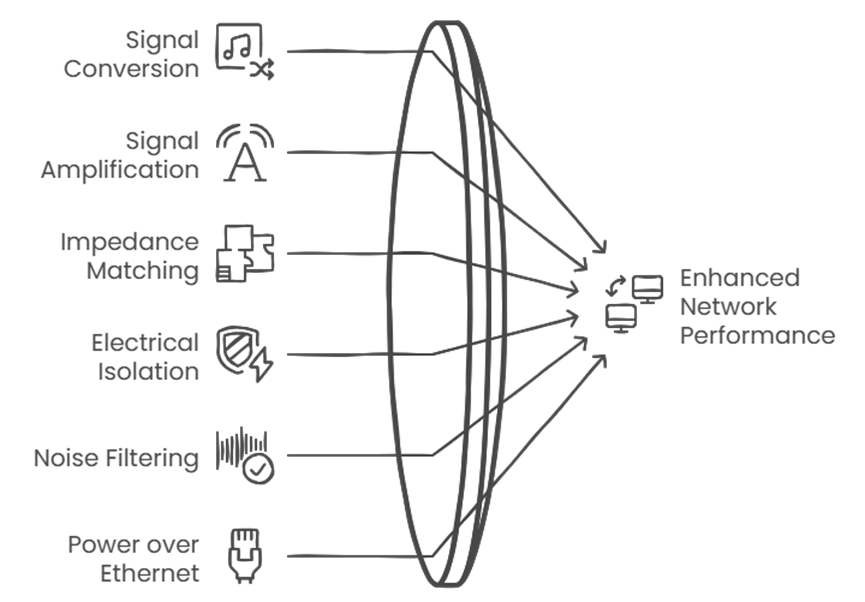
Matching Ethernet Speed to Transformer Specifications
According to Mentech’s guidance on how to choose a lan transformer, the first step is confirming that the transformer supports the required IEEE 802.3 Ethernet standard for the application, whether that involves 100M, 1G, or 10G data rates. Mentech’s own product range reflects this range of speed requirements, covering 10/100/1000M BASE-T as well as 2.5G, 5G, and 10G BASE-T configurations, giving engineers a starting point for narrowing down candidates based on the network speed a device is designed to support.
Turns Ratio and Impedance Considerations
Turns ratio describes the ratio between a transformer’s primary and secondary windings, which affects how voltage and current are transferred between the device and the cable. This parameter works alongside impedance matching, which ensures the impedance of the network device and the connected cable are aligned closely enough to minimize signal reflections. A mismatch in either turns ratio or impedance can reduce transmission efficiency and introduce signal distortion, which is why both parameters are typically reviewed together rather than in isolation during component selection.
Insertion Loss and Return Loss: Measuring Signal Quality
Insertion loss and return loss are two of the most direct indicators of how well a LAN transformer preserves signal quality. As defined in Mentech’s parameter guide, insertion loss refers to signal power loss during transmission through the transformer, with a smaller value indicating less signal loss and higher transmission efficiency.
Return loss, by contrast, measures signal reflection caused by impedance mismatch, expressed in decibels, where a higher value indicates less reflection and better signal matching. Reviewing both figures together provides a clearer picture of how a given transformer will perform within a specific Ethernet interface than either parameter alone.
Isolation Requirements for Different Equipment
Isolation requirements vary depending on the equipment and environment a LAN transformer will operate within. Mentech’s traditional LAN transformer line, for instance, offers HDBaseT-compatible isolation surge protection up to 6KV, a level suited to equipment exposed to more demanding electrical conditions, including automotive networking applications, while also supporting Power over Ethernet applications up to 150W for devices that need to deliver power alongside data.
Devices operating in more controlled environments, such as compact consumer or IoT hardware, may not require this same isolation level, which is part of why isolation rating is a factor considered alongside data rate and impedance rather than treated as a fixed requirement across all applications.
Package Size and Operating Conditions
Package format and operating temperature range also shape which LAN transformer is appropriate for a given design. Traditional LAN transformers use a toroidal core construction and are available in single-port, dual-port, and quad-port configurations, generally suited to discrete network equipment with more available board space. Chip LAN transformers use a smaller chip-based core manufactured on fully automatic equipment, with an operating temperature range of -40°C to +85°C, making them a better fit for compact, high-density PCB layouts found in embedded systems and IoT devices.
Matching Specifications to PHY, Ethernet Interface, and PCB Design
Beyond individual parameters, Mentech’s selection guidance emphasizes ensuring that a LAN transformer’s operating frequency range and insertion loss characteristics align with the broader Ethernet interface and PHY chip it will connect to.
A transformer specified without this alignment in mind may technically support the correct data rate on paper while still underperforming once integrated into the finished PCB layout, since signal routing, connector placement, and PHY chip characteristics all interact with the transformer’s own electrical behavior.
This is why LAN transformer selection is generally treated as part of the broader PCB and interface design process rather than a standalone component decision made in isolation.
Standard Products vs. Custom Development
For many network equipment designs, standard catalog LAN transformers, available in single, dual, and quad-port configurations across a range of established data rates, are sufficient to meet project requirements. Where a design calls for a non-standard turns ratio, an unusual footprint, or isolation and POE characteristics outside a manufacturer’s existing catalog, custom development becomes a relevant option.
Mentech, a transformer and inductor manufacturer, offers both a standard LAN transformer product range and custom development services, allowing engineering teams to source a catalog part where one fits, or work with a manufacturer directly when a project’s specific PHY, interface, or PCB constraints call for a tailored solution.
Closing Perspective
Choosing a LAN transformer involves more than matching a data rate to a part number. Ethernet speed, turns ratio, impedance, insertion loss, return loss, isolation rating, package size, and operating temperature all interact with one another, and with the surrounding PHY and PCB design, to determine whether a given component will perform as expected once integrated into a finished network device.
Reviewing these parameters together, rather than checking them off individually, remains the more reliable approach to selecting a LAN transformer suited to a specific Ethernet application.